

Committees for this Shabbaton included:
Leaders of
the Retreat/Logistics: Talia and Ranen
Rituals: Josh G, Rachel, Oliver, Hillel, Adin, Isabel,
Izzy
Program: Hannah, Shayna, David, Emma, Naomi, Josh P.
Games/Bonding: Galia, Sarah, Daniel
Maagal Lila: Zoe and Micaela
Check out our photos here!
Fellows from each of the committees reflect below on their experience in planning and implementing:
Check out our photos here!
Fellows from each of the committees reflect below on their experience in planning and implementing:

I stepped on to the bus at the JCC, fully equipped with my
"leader of the day" headband on, ready for the weekend that my cohort
and I had been preparing for months.
The theme of our second Shabbaton was self management. Each
fellow was placed in a committee, whether that be Rituals, Games/bonding,
Program, or Maagal Lila. Talia and I were chosen to be the "leaders
of the retreat", which meant that rather than being assigned to a
committee like everyone else in the cohort, we were responsible for the
logistics of the entire retreat. For months, we designed the schedule of
the Shabbaton. We coordinated with the other groups about their needs regarding
time constraints, and organized all the activities for the weekend. Scheduling
was the most difficult process in the planning of the Shabbaton, but it taught
me how to work collaboratively with many people and improved my communications
skills. In addition, Talia and I planned a Tikkun Olam program for the retreat.
The program looked at two different songs, "One Day" by Matisyahu,
and "Imagine", by John Lennon. The objective of the activity was to
examine the lyrics of each song and connect it to the ideals of Tikkun Olam,
and how we can use music as a form of motivation to do good deeds.
After months of hard work, the time had finally come. As the
bus departed Newton and made its way towards Camp Ramah, Liana sat with Talia
and I and we reviewed our responsibilities for the weekend. We were to guide
the cohort through the whole weekend; maintaining the schedule, waking up on
time in the morning, and having a heightened presence in the activities planned
by the other fellows. Being a "leader of the retreat" put us in a
position where we needed to find balance. While we had more authority and
responsibilities than anyone else for the weekend, we had to remember that we
still members of the cohort. We needed to know when to take a step back and let
the other fellows lead us.
That, to me, was the most amazing aspect of the whole
weekend. While most of the time I felt as though I was in somewhat of a
position of power, I was also being lead by the rest of the cohort - by my
friends. Liana said that "This Shabbaton was meant to be 50% self
management, but in truth it was really 80% self management." Liana was
absolutely right, and that still continues to amaze me. Looking back, I am
captivated by the way that our cohort managed to guide each other. We really
ran the show ourselves, and knowing that we are only in the beginning stages of
our Diller experience makes me very excited for the future - for our future.
When I- or rather my
grumbling mother- pulled up to the JCC for Cohort 5’s second shabbaton, I was
completely at ease. My mind was balanced, my soul was on fire, and my body was
ready. Then I realized I forgot to print my D’var Torah, and it all went to
pieces.
Kidding. What actually happened was that I announced this mistake to the entire
crew (we got the right size school bus this time, so we were all sitting
comfortably) and I was told that it would be okay, so my oxygen flow came back.
In typical Diller fashion, we analyzed the problem and found a solution- I
would have to write out my D’var by hand. Being one of the less religious
members of the cohort, I choked back a small bit of frustration- instinctually
I just wanted to say “why can’t I just take advantage of the miracle of Google
Docs and read it from my phone?”- and agreed to get it done that night.
For this shabbaton I was part of the Rituals committee. We were in
charge of planning Oneg Shabbat, Kabbalat Shabbat, the Saturday morning
service, and Havdallah. In all honesty, I didn’t know the difference between
these ceremonies prior to planning them; I’d heard the terms thrown around, but
I sort of just smiled and nodded whenever they were mentioned. However, I
couldn’t get around educating myself for this, which is one of the primary
reasons I chose this committee. Our seven-person group synecdochically
represented the pluralism for which Diller strives: we had kids who were fluent
in Hebrew, and kids who hadn’t stepped foot in a synagogue in years. To
celebrate this spectrum, we chose to make some of our rituals traditional, and
others progressive.
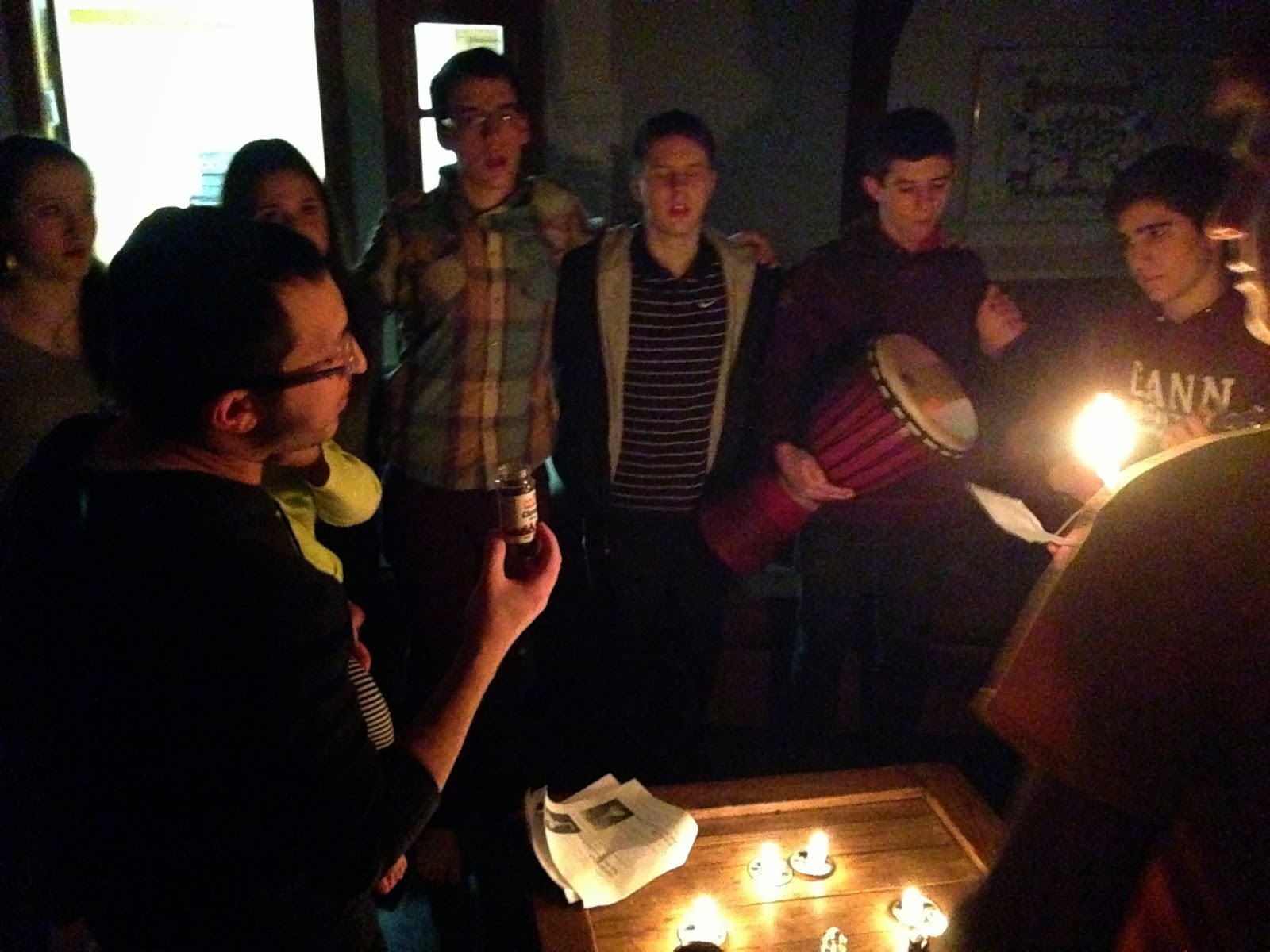
We kicked off the weekend with a classic Kabbalat service, led by
Oliver and Adin, who hit the ball out of the park with astonishingly little
preparation. That’s Gann for you. Our Oneg consisted of a discussion about
gender roles in the Chabad community with our rabbi-in-residence, Shmaya, and
his wife Aliza. Feedback on this was positive: I think every member of the
cohort learned something new about a sect of Judaism none of us grew up in. Our
Saturday morning service fused the traditional and progressive together, and it
was a little shaky, but we pulled through. We stumbled through some prayers,
and then each member of the committee gave his or her D’var. I had some trouble
reading my own handwriting, but Times New Roman will have my back next time, so
it’s all good. Josh and Hillel then conducted a new age-y meditation, which was
laugh-inducing yet innovative. And finally that night we ran a classic
Havdallah service- Oliver played the ukelele, which added a melodious note to
the experience.
I was proud of how our team performed. We struggled with
communication before the retreat but everyone focused superbly once we were at
Camp Ramah, and I think any internal ambiguity was largely undetectable to the
rest of the cohort. I would like to praise Rachel for taking administrative
control of the committee; someone had to do it. The boys were truthfully very
impressive with their mastery of the services, and Izzy and I were consistently
engaged in preparing for and completing our delegated tasks. The rest of the
group, including the staff, helped us out a ton by going with the flow and
fully participating in the rituals we’d prepared. Self-management is always
scary, but having each other as a safety net allowed us to succeed.

Based on
my experience from last Shabbaton, I was more than excited for the upcoming
weekend. Last Shabbaton I was the leader of the retreat, so I was particularly
looking forward to being able to experience the trip in addition to lead an
activity. I was in a group with Shayna Levitan and David Grossman. As a part of
the programming group, our task was to teach our Cohort all about how we can
progress as individuals and as a group in terms of leadership. Our program was
featured on Friday night, what better way to start a leadership retreat than
identifying our own leadership styles in comparison to other individuals within
the group?
Our
activity required a lot of communication and effort in advance. We started
planning in-depth around two months in advance which gave us the time to design
our program easily and accommodate the schedules of the people in our group. At
first, we started planning two programs as a group of six which proved to be
very difficult. Based on this, we decided to split up into two mini-groups to
focus on the separate programs/activities. Within my group, we capitalized on
the use of google hangouts and google docs, collaboratively working and
commenting when we could to progress to our goal. At one point, Shayna and I
met half-way in Dedham to talk about a plan. If we were to do this again, I
would recommend a similar communication strategy, although to confirm that
every person in the group is on board with the concrete plan before leading the
activity.
We
decided to take an interactive approach to our program through forcing the
group to get up on their feet and place themselves on a coordinate plane based
on their position on a statement that we read to the group. This was similar to
an agree-disagree activity although the major difference was instead using one
line to define your answer, we incorporated an additional question that was
“graphed” on the y-axis. Below is a picture of an example of this
“coordinate-plane” concept. When we initially introduced this idea to the
group, it was difficult to conceptualize until we provided them with a visual
aid (similar to the picture below). Some of the questions we asked the group
included: What do you do when something goes wrong? Do you prefer to lead large
or small groups? Are you more likely to speak out or hesitate to state your
opinions? As we figured out our own positions on the chart, we could call other
participants out and say they should be in a different spot on the axis. For
example, if someone was very vocal although they placed themselves in a
position where they hesitate to state their opinions, someone in the group may
call them out and reposition the vocal person closer to more-vocal on the
scale. After graphing ourselves, we had a group discussion on what kind of
leader we were and what everyone else in the group can do to support you.
Overall,
we were really happy about the result of the program. I think that everyone
really opened up to the group and we got to understand a new perspective on how
to best support or actively-follow different individuals within the group.

For this Shabbaton, the
Fellows were expected to prepare and lead half of the Shabbaton, and it seems
as though we have gone above and beyond what was expected of us. The Shabbaton
was announced to us several weeks early to give us time to plan our designated
activities for the Shabbaton. We all chose committees. For example, I was one
of three people in the Games and Bonding committee. Our job was to create
activities that would strengthen the Fellows as a community, while being
relaxed and having fun at the same time. Over the course of the next few weeks,
our group met several times, both face to face, and over Skype. By the time the
Shabbaton came along, we were truly prepared for whatever was coming for us.
Diller retreats have a
lot of introspective and intellectual activities throughout the Shabbaton, so
we decided that it was best to have some light, relaxing, but active games to
play throughout the Saturday. We already had experience with a Shabbaton, since
this was our second retreat, and this experience came in handy.
When we were at camp,
the games and bonding group would check in on itself to insure that everything
was going to plan, and that there would be no problems up ahead. This was
crucial because it was realized that there was a problem that needed
fixing. We kept our heads cool, though, and were able to recreate the plan to
prevent anyone getting too bored or too tired during our activities.
By the time it was our
turn to run the Shabbaton, we were fully prepared and updated. We started by
leading a team building activity in which the Fellows had the task of dragging
a large branch’s tip through a maze, using only long ropes connected to said
branch. That is all that they were told to do. They were not given
instructions, and their only prohibition was to touch the branch. The Fellows
instantly formed a single organism, communicating and coordinating to insure
that the stick stayed upright and within the maze’s walls. They succeeded
fantastically. They truly united and bonded to complete a simple goal, but the
methods of communication and cooperation were fantastic. They functioned as a
single unit. After this, we led a few game of high speed “tag” where the teens
were able to let out all of their pent up energy.
That night, during our
second activity block, we conducted what we called a “mock fashion show”. This
was where people would take random, crazy objects, and perform a skit using
those objects. It was truly hilarious, and made the Fellows bond and grow
closer to one another on a new level.
As
a whole, the Shabbaton was a fantastic bonding experience where everyone had
the opportunity to decompress and relax after the inevitably busy and stressful
week. When we entered Camp Ramah together, we left all of our worldly worries
behind. For one weekend, it was just the twenty-seven of us, growing as a
community.

This past weekend Cohort
5 had its second Shabbaton, and somehow it was even better than the last. The
theme of this Shabbaton was leadership, so naturally we were more focused on
self management and being in charge of more than half of the programs. Zoe
Federman and I were in charge of running the Friday night Maagal Layla. I had
never realized how much planning went into each every one of these programs, I
guess the staff just made it look easy. We had to take a lot of time out of
daily lives to plan for this Maagal. All along, we knew we wanted it to be
special. We wanted to have activities where everyone could get to know each
other as people, rather than just the idea of the group. The last couple of
weeks leading up to the Shabbaton were very stressful for a lot of people, so
when we got to Ramah we had to make sure we sensitive to any issues. We planned
two activities, one called “Take a Step Forward If…” Where we asked various
questions ranging from whether or not you sing in the shower to whether or not
you support the death penalty. This was a great way to physically see
commonalities and differences between the fellows.
Our
second activity was called “If You Really Knew Me You Would Know…” Where our
purpose was to sit in a circle and really learn about everyone’s lives. We
asked questions that were more personal like, “The scariest moment of my life
was…” or “I believe God is…” More than anything, we wanted to create a safe
environment where people were able to be vulnerable and open up about our
personal experiences, opinions, and thoughts. After both of these activities we
did short debriefs to talk about what everyone thought of the activities or add
additional thoughts. Overall, the Maagal Layla went really well. We were able
to spark deep conversation among the group and share some things that would be
otherwise hard to admit.
The rest of the retreat was amazing. It was incredible to see all of the
fellows plan the majority of the weekend with such ease. We learned more about
what we’re going to be doing in Israel, Tikkun Olam, and other really important
aspects of Diller that we hadn’t necessarily gotten to yet. This retreat only made
me even more excited for the next workshop and everything else to come!


